The word witch has been flattened into a visual. Black candles, dramatic altars, the right crystals arranged in the right order. A particular kind of fog-filter Instagram post. A costume.
That is not what this practice is.
Witchcraft, in its honest and ancestral form, is attention. It is the discipline of noticing the intelligence woven into ordinary things and choosing to work with it rather than walking past it oblivious. It is the woman who knows which herb to reach for when the air in her home feels heavy. The one who marks the moon not because it is aesthetic but because she has learned her own rhythms mirror it. The one who tends her altar the way she tends herself — with care, with presence, with respect for what is actually there.
If you have felt drawn to this practice, you probably already know some of it. The way you instinctively open windows after an argument. The way certain places drain you and others fill you without obvious reason. The way your body knows things before your mind catches up.
That is not coincidence. That is an attunement you were born with.
What everyday practice actually looks like.
It is simpler than the internet would have you believe and more demanding at the same time. Because the real work is not acquiring more tools. It is bringing your full attention to what you already have.
A morning where you take three slow breaths before reaching for your phone is a ritual. Cooking with care and intention rather than efficiency is a ritual. Stepping outside at night and noticing the moon — whatever phase she is in — is a ritual. Tending a plant, lighting a candle with something specific in mind, writing down what you want to release at the end of the week and meaning it. These are not performances. They are agreements with yourself.
The practice builds through repetition. Not through perfection.
On working with herbs and plants.
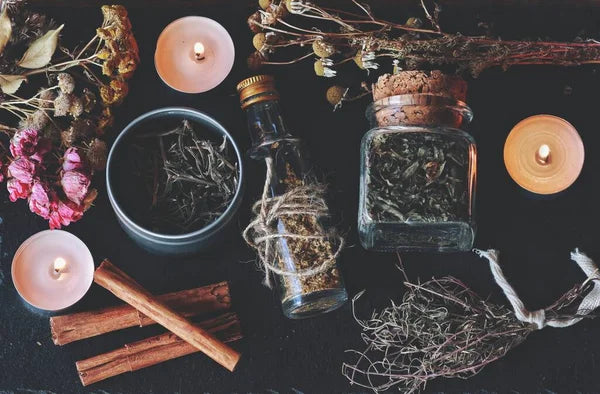
Plants are some of the most accessible allies in this practice. Rosemary for clarity and protection. Lavender for calm and the easing of difficult transitions. Cedar for grounding and ancestral connection. Mugwort for dreamwork and the threshold between waking and sleep.
You do not need a witchcraft shop or a curated collection. Start with what grows nearby, what already lives in your kitchen, what calls to you when you pass it. The relationship between you and a plant builds over time through attention, not acquisition.
On building an altar.
An altar is not a decoration. It is a focal point for your practice — a place where you concentrate your intention and tend it regularly. It can be a single shelf, a corner of a windowsill, a small tray on your bedside table.
What goes on it is less important than the attention you bring to it. A stone from somewhere meaningful. A candle. Something from the earth. A photograph of someone you love or someone who has passed. Whatever feels like it belongs there. Tend it the way you tend anything living — with regular attention rather than one grand gesture.
On making this your own.
There is no single correct form of this practice. There are traditions, lineages, and ways of working that deserve respect and study. And within that, there is also your own particular nature — the specific way you perceive, the specific things that call to you, the specific relationship you have with the earth and with the unseen.
Trust that. The practice that actually changes you will be the one you build honestly from what is real in your life, not the one you assembled to match someone else's aesthetic.
The magic was always in the attention. It was always in you.